
Aruba Networks - Wireless LAN SolutionsAruba AP-135 Access Points

Features two 3x3 MIMO dual-band 2.4-GHz/5-GHz radios with internal antennas.
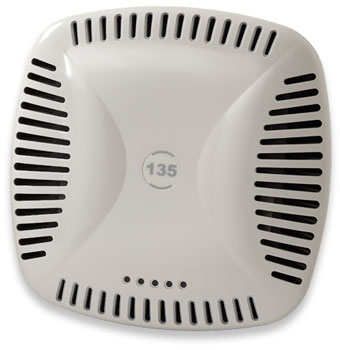
Aruba AP-135 Access Point

Aruba Networks Products
Aruba Wireless Access Points
Aruba AP-135 Wireless Access Point AP-135
List Price: $1,295.00
Our Price: $1,100.00

Click here to jump to more pricing!

Aruba AP-135 Access Points:

Overview:

The AP-134 and AP-135 indoor 802.11n access points (APs) maximize performance for mobile devices in extremely highdensity Wi-Fi environments and ensure strong threat protection using integrated MACSec* security.

These multifunctional APs deliver wire-like performance at data rates up to 450 Mbps per radio. Taking advantage of 802.11n technology, the AP-134 and AP-135 employ three spatial streams to deliver 50% more throughput and support 50% more mobile devices in high-density environments compared to previous-generation APs.

The AP-134 features two 3x3 MIMO dual-band 2.4-GHz/5-GHz radios with external antenna interfaces, while the AP-135 features the same radios with internal antennas. Both are built to provide years of trouble-free operation and are backed by a limited lifetime warranty.

MACSec authentication and encryption on Ethernet ports enable secure AP deployment by interoperating with the MACSec capability on Aruba Mobility Access Switches and other wiring closet devices.

The AP-134 and AP-135 feature dual 10/100/1000BASE-T Ethernet interfaces and operate from standard 802.3af and 802.3at power-over-Ethernet (PoE) sources. The secondary Ethernet interface (active only when supplying 802.3at PoE or DC power to the access point) enables secure authorized backhaul for wired network-attached devices.

Working with Aruba’s line of centralized Mobility Controllers, the AP-134 and AP-135 deliver secure, high-speed network services that move users to a “wireless where possible, wired where necessary” network access model. The network can then be rightsized by eliminating unused Ethernet switch ports and thereby reducing operating costs.

The key to ensuring wire-like performance and reliability is Aruba’s unique Adaptive Radio Management and spectrum analysis capabilities, which manage the 2.4-GHz and 5-GHz radio bands to deliver maximum client performance while mitigating any RF interference.

The multifunction AP-134 and AP-135 can be configured through the Mobility Controller to provide WLAN access with part-time air monitoring for wireless IPS and spectrum analysis. They can be configured as dedicated air monitors within the campus WLAN or can be remotely located. They can enable wireless mesh networking for high performance network backhaul where wired cabling is not available.

AP Video Datasheet:


Specifications:

Aruba AP-134 & AP-135 Access Points Specifications
Application
802.11n indoor APs designed to support maximum performance for maximum client density, with maximum deployment flexibility and security.
Operating Mode
Campus AP, air monitor (AM) and spectrum monitor
Remote AP, AM and spectrum monitor
Radios
Software-configurable dual radio capable of supporting 2.4 GHz and 5 GHz
RF Management
  • Automatic transmit power and channel management control with auto coverage hole correction via Adaptive Radio Management (ARM)
  • Spectrum analysis scans the 2.4-GHz and 5-GHz radio bands to provide increased visibility into non-802.11n RF interference sources and their effect on 802.11n channel quality.
Advanced Features
  • Remote AP, spectrum analysis, secure enterprise mesh and wireless intrusion protection
  • MACSec security for authorization and data encryption between the AP ports and the wired access layer (requires MACSec support on the wired edge switch)
  • Integrated Trusted Platform Module (TPM) for secure storage of credentials and keys
  • SecureJack-capable for secure tunneling of wired Ethernet traffic
Antenna
AP-134: Three RP-SMA antenna interfaces for external dual-band antennas
AP-135: Six internal downtilt omni-directional antennas; three per frequency band
2.4 to 2.5 GHz/3.5 dBi
5.150 to 5.875 GHz/4.5 dBi
Wireless Radio Specifications
AP type: Dual-radio, dual-band 802.11n indoor
Supported Frequency Bands (country-specific restrictions apply): 2.400 - 2.4835 GHz
5.150 - 5.250 GHz
5.250 - 5.350 GHz
5.470 - 5.725 GHz
5.725 - 5.850 GHz
Available Channels: Controller-managed, dependent upon configured regulatory domain
Supported Radio Technologies: 802.11b: Direct-sequence spread-spectrum (DSSS)
802.11a/g/n: Orthogonal frequency division multiplexing (OFDM)
802.11n: 3x3 MIMO with up to three spatial streams
Supported Modulation Types: 802.11b: BPSK, QPSK, CCK
802.11a/g/n: BPSK, QPSK, 16-QAM, 64-QAM
Transmit Power: Configurable in increments of 0.5 dBm
Maximum Transmit Power (aggregated for three active transmit chains): 2.4 GHz: 23 dBm (limited by local regulatory requirements)
5 GHz: 23 dBm (limited by local regulatory requirements)
Maximum Ratio Combining (MRC) for improved receiver performance
Short guard interval for 20-MHz and 40-MHz channels
Space Time Blocking Code (STBC) for increased range and improved reception
Low Density Parity Check (LDPC) for high efficiency error correction and increased throughput
Transmit Beam-forming (TxBF) ready platform for increased reliability in signal delivery
Association Rates (Mbps): 802.11b: 1, 2, 5.5, 11
802.11a/g: 6, 9, 12, 18, 24, 36, 48, 54
802.11n: MCS0 – MCS23 (6.5 Mbps to 450 Mbps)
802.11n High-Throughput (HT) Support: HT 20/40
802.11n Packet Aggregation: A-MPDU, A-MSDU
Power
48 V DC 802.3af PoE or 802.3at PoE+
12 V DC external AC supplied power (adapter sold separately)
Maximum power consumption: 15 watts
Interfaces
Network:
  • 2x10/100/1000BASE-T Ethernet (RJ-45), auto-sensing link speed and MDI/MDX
  • Supports MACSec encryption, 802.3az (EEE)
  • 48 V DC 802.3af PoE or 802.3at PoE+ interoperable with intellisource power sourcing equipment (both ports)
Antenna (model AP-134 only): 3 x RP-SMA antenna interfaces (supports up to 3x3 MIMO)
Other: 1 x RJ-45 console interface
Mounting
Standard: Wall mounting using built-in mount features
Recessed ceiling-tile rail mounting using one of two adapters supplied with the AP (9/16” and 15/16” rails)
Optional mounting kit: Wall-mount bracket for offset wall mounting, providing spacing between wall and unit (cable bend radius)
Security: Kensington security lock point
Mechanical
Dimensions / Weight:
  • Unit: 760 g (1.68 lb), 170 mm x 170 mm x 45 mm (6.69” x 6.69” x 1.77”)
  • Shipping box: 1,050 g (2.31 lb), 285 mm x 240 mm x 70 mm (11.22” x 9.45” x 2.76”)
Environmental
Operating: Temp: 0° C to +50° C (+32° F to +122° F)
Humidity: 5 to 95% non-condensing)
Storage and Transportation Temperature Range: Temp: -40° C to +70° C (-40° F to +158° F)
Regulatory

FCC/Industry of Canada
CE Marked
R&TTE Directive 1995/5 EC
Low Voltage Directive 72/23/EEC
EN 300 328
EN 301 489
EN 301 893
UL/IEC/EN 60950
CB Scheme Safety, cTUVus
Japan MIC/VCCI
Korea KCC
Brazil ANATEL
Mexico NOM/COFETEL
China SRRC/CCC
UL2043 compliant
AS/NZS 4260, 4771, 3548

For more country-specific regulatory information, and approvals, please see your Aruba representative.

Certifications

Wi-Fi certified: 802.11a/b/g/n


Wireless Radio Specifications:

RF Performance Table
Rate AP-134 / AP-135
Transmit power per active transmit chain (dBm) Receive Sensitivity (dBm) Transmit power per active transmit chain (dBm) Receive Sensitivity (dBm)
2.4 GHz 5 GHz
802.11b
1Mbps 18 -97
11Mbps 18 -92
802.11a/g
6Mbps 18 -94 18 -94
54Mbps 16 -81 16 -82
802.11n HT20
MCS0/8/16 17 -94 17 -94
MCS7/15/23 12 -78 12 -78
802.11n HT40
MCS0/8/16 17 -92 17 -92
MCS7/15/23 11 -75 11 -74

RF performance numbers for AP-134 slightly lower due to additional internal RF circuitry.

Antenna Pattern Plots:

Antenna Pattern Plots

Products Comparision:

Aruba Indoor 802.11 a/b/g/n Access Point Description
Aruba AP-68 The multifunction AP-68 and AP-68P2 are low-cost 802.11n access points (APs) for small, very low-density deployments in offices, hospitals, schools and retail stores. The non-MIMO AP-68 has one 2.4-GHz radio with 100-milliwatt transmit power and two internal antennas while the AP-68P has one 2.4-GHz radio with 500-milliwatt transmit power and an external antenna. Both APs provide WLAN access with part-time air monitoring, dedicated air monitoring for wireless IPS, Remote AP (RAP) functionality or secure enterprise mesh.
Aruba AP-92/AP-93 The multifunction AP-92 and AP- 93 are entry-level indoor 802.11n access points (APs) designed for low-density deployments in offices, hospitals, schools and retail stores. The AP-92 features a single 2x2 MIMO dual-band 2.4-GHz/5-GHz radio with external antennas while the AP-93 features the same radio with internal antennas. Both APs can provide WLAN access with part-time air monitoring for wireless IPS and spectrum analysis, dedicated air monitoring for wireless IPS and spectrum analysis, Remote AP (RAP) functionality or secure enterprise mesh.
Aruba AP-105 The multifunction AP-105 is an affordable indoor 802.11n access point (AP) designed for high-density deployments in offices, hospitals, schools and retail stores. It features two 2x2 MIMO dual-band 2.4-GHz/5- GHz radios with two internal omni-directional antennas, plus ceiling and wall mounting options. The AP-105 can provide WLAN access with part-time air monitoring for wireless IPS and spectrum analysis, dedicated air monitoring for wireless IPS and spectrum analysis, Remote AP (RAP) functionality or secure enterprise mesh.
Aruba AP-120/AP-121 The multifunction AP-120 and AP-121 are indoor 802.11n access points (APs) designed for maximum deployment flexibility in low-density environments that require above-ceiling or enclosure-based installations. The AP-120 features a single 3x3 MIMO dual-band 2.4-GHz/5GHz radio with detachable antenna interfaces while the AP-121 features the same radio with integrated antenna elements. Both APs can provide WLAN access with part-time air monitoring for wireless IPS and spectrum analysis, dedicated air monitoring for wireless IPS and spectrum analysis, Remote AP (RAP) functionality or secure enterprise mesh.
Aruba AP-124/AP-125 The multifunction AP-124 and AP-125 are ultra-high-performance indoor 802.11n access points (APs) designed for maximum deployment flexibility in high-density environments. The AP-124 features two 3x3:2 MIMO radios (2.4GHz / 5GHz) with external antenna interfaces while the AP-125 features the same radios with integrated antenna elements. Both APs can provide WLAN access with parttime air monitoring for wireless IPS and spectrum analysis, dedicated air monitoring for wireless IPS and spectrum analysis, Remote AP (RAP) functionality or secure enterprise mesh.
Aruba AP-134/AP-135 The two-radio, multifunction AP-134 and AP-135 are ultra-high performance indoor 802.11n access points (APs) designed for high-density environments. The AP-134 features two 3x3:3 MIMO radios (2.4GHz / 5GHz) with external antenna interfaces while the AP-135 features the same radios with integrated antenna elements. Compared to 3x3:2 and 2x2:2 MIMO radios, AP-134 and 135 radios offer 50% greater aggregate performance. Both APs can provide WLAN access with part-time air monitoring for wireless IPS and spectrum analysis, dedicated air monitoring for wireless IPS and spectrum analysis, Remote AP (RAP) functionality or secure enterprise mesh.
Aruba Indoor 802.11 a/b/g/n Access Point Product Line Matrix
  AP-68 & AP-68P AP-92 & AP-93 AP-105 AP-120 & AP-121 AP-124 & AP-125 AP-134 & AP-135
Applications1
Campus AP Yes (ArubaOS 6.0+) Yes (ArubaOS 5.0.1+) Yes (ArubaOS 3.3.3+ or ArubaOS 3.4.1+) Yes Yes Yes (ArubaOS 6.1+)
Remote AP Yes (ArubaOS 6.0+) Yes (ArubaOS 5.0.1+) ) Yes (ArubaOS 3.3.3+ or ArubaOS 3.4.1+) Yes (ArubaOS 3.3.2+) Yes (ArubaOS 3.3.2+) Yes (ArubaOS 6.1+
Mesh Yes (ArubaOS 6.0+) Yes (ArubaOS 5.0.1+) Yes (ArubaOS 3.3.3+ or ArubaOS 3.4.1+) Yes (ArubaOS 3.4+) Yes (ArubaOS 3.4+) Yes (ArubaOS 6.1+)
Remote Mesh Yes (ArubaOS 6.0+) Yes (ArubaOS 5.0.1+) Yes (ArubaOS 3.4.1+) Yes (ArubaOS 3.4+) Yes (ArubaOS 3.4+) Yes (ArubaOS 6.1+)
Air Monitor (AM) Yes (ArubaOS 6.0+) Yes (ArubaOS 5.0.1+) Yes (ArubaOS 3.3.3+ or ArubaOS 3.4.1+) Yes Yes Yes (ArubaOS 6.1+)
AP and AM Yes (ArubaOS 6.0+) Yes (ArubaOS 5.0.1+) Yes (ArubaOS 3.3.3+ or ArubaOS 3.4.1+) Yes Yes Yes (ArubaOS 6.1+)
Spectrum Analysis No. Yes. Spectrum analysis (enabled with ArubaOS 6.0+) remotely scans the 2.4-GHz and 5-GHz radio bands to identify sources of RF interference. This provides visibility into non-802.11 RF interference sources and their effect on 802.11 channel quality. Monitors 4.9GHz frequency band when in dedicated Air Monitor (AM) mode. Yes. Spectrum analysis (enabled with ArubaOS 6.0+) remotely scans the 2.4-GHz and 5-GHz radio bands to identify sources of RF interference. This provides visibility into non-802.11 RF interference sources and their effect on 802.11 channel quality. Interference classification, real-time FFT and Spectograms are not supported on AP-12x series. Monitors 4.9GHz frequency band when in dedicated Air Monitor (AM) mode. Yes. Spectrum analysis remotely scans the 2.4-GHz and 5-GHz radio bands to identify sources of RF interference. This provides visibility into non-802.11 RF interference sources and their effect on 802.11 channel quality.
Number of Radios Single Radio Single Radio Dual Radio 3 Single Radio Dual Radio 3 Dual Radio 3
Operating Frequencies 2.4-2.5 GHz
Radio channel availability is centrally managed by the controller, based on configured regulatory domain
.4-2.5 GHz
5.150-5.950 GHz
Radio channel availability is centrally managed by the controller, based on configured regulatory domain
DFS Support Not applicable Yes (ETSI/EU, MKK/JP), planned (FCC/US) Yes (ETSI/EU, MKK/JP), planned (FCC/US) Yes Yes Yes (ETSI/EU, MKK/JP), planned (FCC/US)
RF Management Adaptive Radio Management (ARM) provides dynamic, application-aware channel management to maximize network capacity and ensure fairness in bandwidth availability per user. Capabilities include adaptive power and channel assignments, coordinated access to a single channel, band steering, channel load balancing, airtime fairness, airtime performance protection and coverage hole detection. In addition, spectrum analysis remotely scans the 2.4-GHz and 5-GHz radio bands to identify sources of RF interference. This provides visibility into non-802.11 RF interference sources and their effect on 802.11 channel quality.
Antennas AP-68: Integrated, omni-directional antenna elements (supporting receive spatial diversity). Antenna gain: 3 dBi (max)
AP-68P (available only in China): RP-SMA interface for external antenna support
AP-92: Dual RP-SMA interfaces for external dual-band antenna (supports 2x2 MIMO spatial diversity)
AP-93: Integrated, dual, omni-directional dual-band dipole (supports 2x2 MIMO spatial diversity)
Integral, Dual, Omni-directional Dual-Band dipole (supports 2x2 MIMO spatial diversity) AP-120: Tri (3x3), RP-SMA interfaces for external antenna support (supports 3x3 and below MIMO spatial diversity)
AP-121: Integral, Tri (3x3), Omni-directional Dual-Band dipole (supports 3x3 and below MIMO spatial diversity)
AP-124: Tri (3x3), RP-SMA interfaces for external antenna support (supports 3x3 and below MIMO spatial diversity)
AP-125: Integral, Tri (3x3), Omni-directional Dual-Band dipole (supports 3x3 and below MIMO spatial diversity)
AP-134: Three RP-SMA antenna interfaces for external dual-band antennas (supports 3x3 and below MIMO spatial diversity)
AP-135: Six internal downtilt omnidirectional antennas; 3 per frequency band (supports 3x3 and below MIMO spatial diversity)
Network Interfaces 1 x 10/100BASE-T Ethernet (RJ- 45), auto-sensing link speed and MDI/MDX 1x10/100/1000BASE-T Ethernet (RJ-45), auto-sensing link speed and MDI/MDX 1x10/100/1000BASE-T Ethernet (RJ45), Auto-sensing link speed and MDI/MDX 2x100/1000BASE-T Ethernet (RJ45) , Auto-sensing link speed and MDI/ MDX 2x100/1000BASE-T Ethernet (RJ45) , Auto-sensing link speed and MDI/ MDX 2x100/1000BASE-T Ethernet (RJ45), Auto-sensing link speed and MDI/DX Supports MACS
Other Interfaces Console interface (RJ-45) Console interface (RJ-45) Console interface (RJ45) Console interface (RJ45) Console interface (RJ45) Console interface (RJ45)
Power over Ethernet (PoE) Interfaces 48 V DC 802.3af compliant 48 V DC 802.3af compliant 48 V DC 802.3af compliant 48 V DC 802.3af or 802.3at or PoE + inter operable with intelli-source PSE sourcing intelligence (both ports) 48 V DC 802.3af or 802.3at or PoE + inter operable with intelli-source PSE sourcing intelligence (both ports) 48 V DC 802.3af or 802.3at or PoE+ inter operable with intelli-source PSE sourcing intelligence (both ports)
DC Power Interfaces 12 V 12 V, 1.25 A 12 V , 1.25 A 5 V, 2.4 A 5 V, 3.2 A 12 V, 1.25A
Power Consumption 8 watts (maximum) 10 watts (maximum) 12.5 watts (maximum) 12 watts (maximum) 16 watts (maximum) 15 watts (maximum)
Environmental
Class Indoor Indoor, plenum-rated Indoor, plenum-rated Indoor, plenum-rated Indoor, plenum-rated Indoor, plenum-rated
Operating Temperature 0° C to +40° C (+32° F to +104° F) 0° C to +50° C (+32° F to +122° F) 0° C to +50° C (+32° F to +122° F) 0° C to +50° C (+32° F to +122° F) 0° C to +50° C (+32° F to +122° F) 0° C to +50° C (+32° F to +122° F)
TAA Planned Planned Yes No No No
TAA/FIPS (AP HW) Planned Planned Planned No Yes Planned
FIPS (SW) Planned Planned Planned ArubaOS 3.3-FIPS ArubaOS 3.3-FIPS Planned
CC-EAL Planned Planned Planned Planned Planned Planned
Product Warranty 1 year parts and labor Limited lifetime Limited lifetime Limited lifetime Limited lifetime Limited lifetime
1Number in parenthesis indicates minimum ArubaOS version
2 Available in China only
3 Concurrent operation of both radios in the same frequency band (2.4 GHz / 5 GHz) is not supported


Aruba Networks Products
Aruba Wireless Access Points
Aruba AP-135 Wireless Access Point AP-135
List Price: $1,295.00
Our Price: $1,100.00
Aruba Access Point Accessories
Aruba AP-130 Series Mounting Kit AP-130-MNT
Our Price: $25.00
