
Aruba Data Center
Modern data center networking for edge-to-cloud. Automate IT operations, accelerate service delivery, and deliver a cloud-like operational experience.
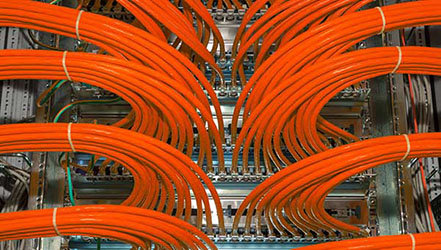
Modern Data Center Networking Portfolio
Solutions to power modern, next generation edge-to-cloud centers of data.
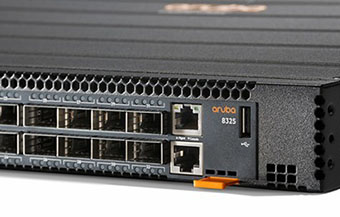
Campus Core and Data Center Switches
- Simplified IT ops
- Accelerated services provisioning
- Increased visibility and control
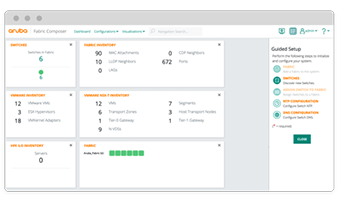
Aruba Fabric Composer
- Simplifies ops and troubleshooting
- Accelerates leaf-spine network fabric provisioning across rack-scale compute and storage infrastructures
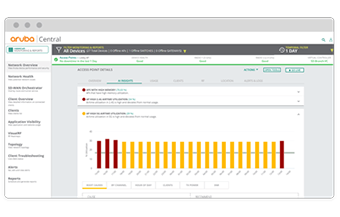
Switch Software: AOS-CX
- Simplifies network ops with automation, distributed analytics, security, and high availability
- Policy-driven segmentation and AI-powered capabilities
The Shift to Distributed Centers of Data Means Challenges
Traditional data centers were built with siloed infrastructure layers, purpose-built hardware, and fragmented management.
Operational Complexity
Most organizations have disparate network architectures and management tools with multiple switching hardware platforms, operating systems, and licensing or subscription plans.
Slow Service Delivery/SLAs
This operational friction leads to longer lead times because IT spends countless hours on infrastructure requests and manual tasks, while stakeholders demand a faster cloud-like experience.
Difficulty Troubleshooting
In the data center, lack of visibility across both the physical and virtual networks means that IT spends about 70% of their time trying to identify and diagnose issues.
Simplify IT Ops, Speed Up Provisioning, and Save Time
Introducing Aruba's new architectural approach: one that is edge-centric, cloud-enabled, and data-driven.
Built on a microservices based architecture with identical operation for all switches, whether deployed in a data center or campus environment. Aruba is unique here because our common architecture delivers a consistent and cloud-like operational experience across every domain of the enterprise network.
Building on an already robust AOS-CX-based automation framework, Aruba is introducing a new network orchestration solution which solves the problems faced by data center and IT administrators who often struggle with manual and siloed activities for IT service provisioning across compute, virtualization, storage and network infrastructure environments.
Aruba helps HPE's server and storage customers seamlessly extend connectivity to their solutions, to deliver a consistent user experience and operating model. Integrations with HPE and ecosystem partners span a wide range of compute, storage, HCI and cloud offerings, including HPE ProLiant servers, SimpliVity, Nimble dHCI, Synergy, SAP HANA, VMware, and GreenLake Hybrid Cloud.
A New Generation of Switching Architecture
Aruba CX 10000 with Pensando is a new category of data center switch that combines best-of-breed L2/3 switching with the industry's first hardware-accelerated services processor.
Learn More
A Cloud-Native Networking Architecture
The Aruba CX switching portfolio is designed for today's demanding, evolving data center networks. Cutting-edge hardware, a cloud-native operating system, and intuitive management tools reduce risk, improve IT efficiency, and ensure networks are always available.

Accelerate with Software-Defined Automation and Orchestration
Aruba Fabric Composer is an intelligent, API-driven, software-defined orchestration tool that simplifies and accelerates leaf-spine network fabric provisioning across rack-scale compute and storage infrastructures, increasing efficiencies and improving productivity for network operators and server and virtualization admins.
Meet Aruba Fabric ComposerTalk to a Network Specialist
Ready to modernize your data center networking? Our team can help you design and deploy the right solution.
We'll discuss:
- Your current data center architecture
- Performance and scalability requirements
- Automation and orchestration needs
- Integration with existing infrastructure